
 EN
EN
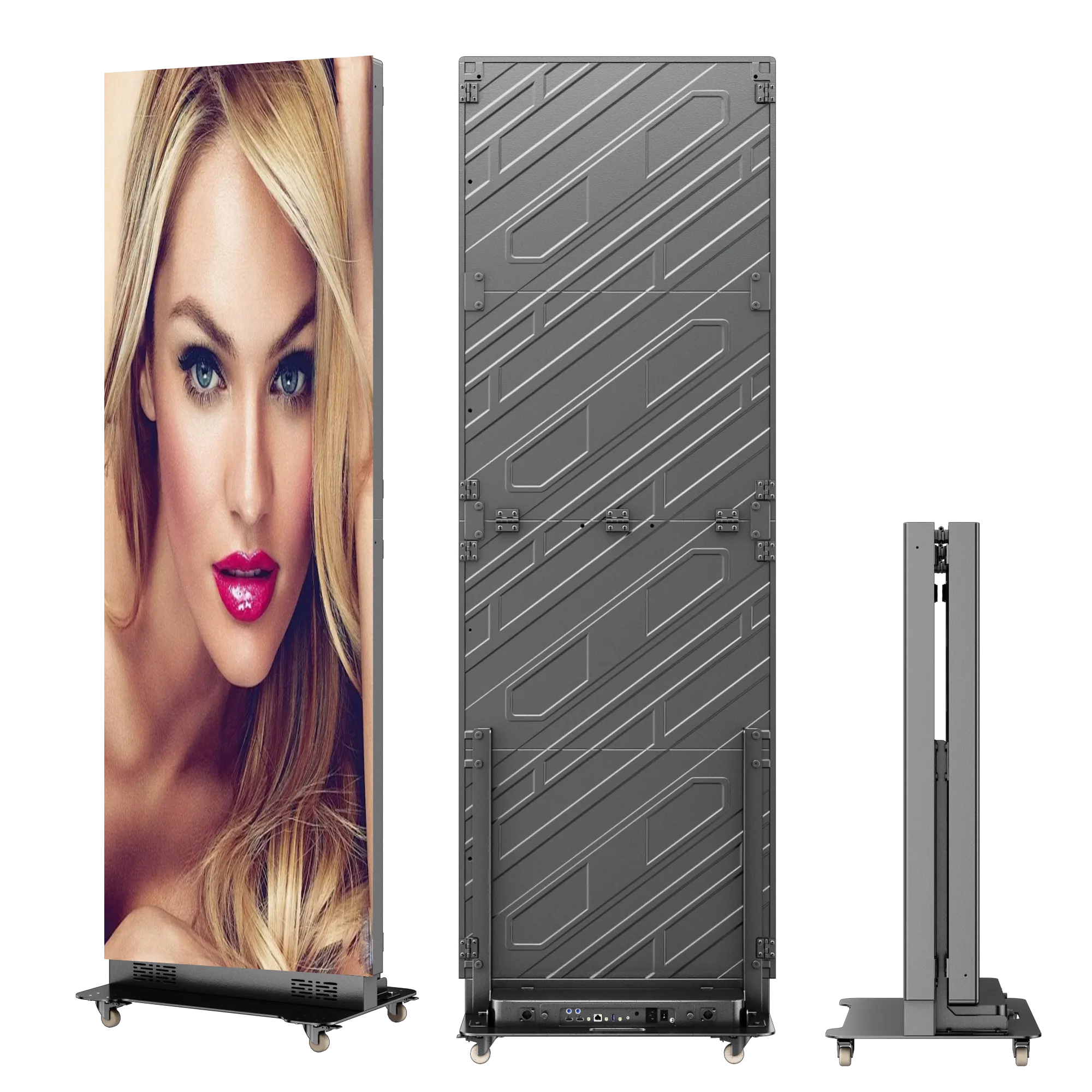
Why Custom LED Display Cabinets Are Essential for Demanding Applications
Off-the-shelf LED displays often fail in challenging environments due to inadequate environmental protection, structural rigidity, or installation constraints—leading to pixel failure, moisture damage, and shortened lifespans in venues like stadiums, architectural facades, or outdoor security monitoring centers. A custom LED display cabinet addresses these limitations through precision engineering: sealed designs achieve IP65+ ingress protection against dust and moisture; modular construction enables seamless alignment, rapid maintenance access, and support for non-planar configurations—including curves, spheres, and irregular geometries; aerospace-grade aluminum alloys ensure thermal stability across wide temperature ranges without warping, preserving pixel integrity; and reinforced internal bracing withstands high wind loads and mechanical stress. These features deliver consistent, high-impact visuals in uncontrolled settings—where downtime is operationally unacceptable and reliability directly impacts ROI.
Key Structural and Material Considerations for Custom LED Display Cabinet Durability
Selecting the right material for a custom LED display cabinet directly influences weight, strength, thermal management, and long-term reliability. The optimal choice balances portability, structural stability, and heat dissipation—guided by application-specific demands.
Aluminum vs. Steel vs. Magnesium Alloys: Weight, Strength, and Thermal Stability Trade-Offs
Iron and mild steel cabinets offer high rigidity but add significant weight—limiting suitability for mobile or suspended installations. Die-cast aluminum strikes an effective balance: it’s 40–50% lighter than steel while delivering superior thermal conductivity, critical for managing heat in high-brightness, continuous-operation applications. Magnesium alloys provide even greater weight reduction and thermal performance but at a premium cost and narrower manufacturing availability. For permanent outdoor deployments, galvanized or powder-coated steel remains viable when paired with robust corrosion protection—but requires careful specification to avoid premature degradation in coastal or high-UV environments. The decision hinges on whether the priority is transport flexibility, long-term dimensional stability, or passive thermal regulation.
Die-Cast Aluminum Frames: Precision, Rigidity, and Long-Term Pixel Alignment Retention
Die-cast aluminum frames are widely regarded as the industry benchmark for high-performance custom LED cabinets. The die-casting process achieves dimensional tolerances of ≤0.02 mm—critical for maintaining sub-millimeter pixel pitch alignment across large-scale or fine-pitch displays. This precision resists warping under repeated thermal cycling (–30°C to +60°C), ensuring visual uniformity over multi-year service life. Unlike extruded or welded alternatives, die-cast frames integrate mounting points, ventilation paths, and cable routing into a single monolithic structure—reducing assembly variables and enhancing mechanical consistency. For installations exceeding 100 m² or requiring seamless tiling, this inherent rigidity prevents visible seams and color shift at panel joints.
Application-Driven Features That Define Custom LED Display Cabinet Performance
In demanding environments—from live-event arenas to transportation hubs—the cabinet must go beyond basic enclosure functionality. Its design must actively sustain image fidelity, enable rapid service, and resist environmental degradation—without compromising structural integrity.
IP65+ Sealing and Reinforced Bracing for Outdoor and High-Stress Environments
True IP65+ protection requires more than gasketed seams: it demands integrated silicone sealing around module edges, pressure-equalizing vents with hydrophobic membranes, and fully encapsulated PCBs. When combined with marine-grade stainless-steel fasteners and UV-stable powder coatings (e.g., Qualicoat Class 2), this system ensures resilience in humid, saline, or high-particulate settings. Reinforced internal bracing—strategically placed cross-members and torsion-resistant corner blocks—maintains cabinet flatness under dynamic loads, including wind gusts up to 150 km/h and vibration from adjacent infrastructure. Independent testing per IEC 60529 and ISO 1461 confirms that certified IP65+ cabinets retain optical performance after 96 hours in accelerated environmental chambers simulating rain, salt fog, and thermal shock.
Front-Maintenance Design: Balancing Service Efficiency with Structural Integrity
Front-access cabinets eliminate the need for rear service corridors—enabling flush wall-mounting, ceiling integration, or tight-space installations where rear clearance is impossible. Achieving this without sacrificing rigidity requires engineered solutions: dual-stage locking mechanisms with stainless-steel latches, front panels reinforced with internal ribbing and aluminum honeycomb cores, and load-distributed hinge systems rated for ≥50,000 cycles. When properly executed, front-maintenance reduces average module replacement time by 60–70% versus rear-access alternatives—cutting labor costs and minimizing operational disruption—while preserving flatness within ±0.15 mm across 2 m² panels over 5+ years of use.
How to Evaluate and Select the Right Custom LED Display Cabinet Partner
Selecting a partner demands verification—not just claims—of engineering rigor, materials integrity, and field-proven durability. Begin by auditing their precision manufacturing capabilities: request dimensional inspection reports validating ≤0.02 mm tolerance on die-cast aluminum frames, confirming pixel alignment stability across thermal cycles. Require evidence of structural validation—such as third-party accelerated lifetime testing exceeding 2,000 hours under combined thermal, humidity, and vibration stress per IEC 60068-2 standards. Review warranty terms not just for duration, but scope: coverage should extend to frame deformation, seal integrity, and thermal-induced pixel drift—not just LED module failures. Insist on documented MTBF data (≥50,000 hours for cabinet-level assemblies) and full materials test reports—including ASTM B117 salt-spray results showing no red rust after 1,000 hours and ISO 4892-2 UV exposure data confirming no measurable warpage or coating delamination after 6,000 hours. Finally, assess support responsiveness: partners with dedicated field engineering teams, spare-part logistics aligned to regional demand, and transparent root-cause resolution workflows consistently achieve >95% first-time fix rates—directly translating to lower total cost of ownership.
FAQ
What is a custom LED display cabinet?
A custom LED display cabinet is a precision-engineered enclosure designed to house LED displays. It ensures optimal performance by addressing specific structural, environmental, and operational requirements, offering features like IP65+ protection, modularity, thermal stability, and durability.
What are the advantages of die-cast aluminum for LED cabinets?
Die-cast aluminum offers excellent precision, rigidity, and thermal conductivity. It ensures stable pixel alignment, resists warping under extreme temperatures, and integrates mounting points and ventilation paths for enhanced durability over time.
How do I choose the right custom LED display cabinet manufacturer?
Focus on precision manufacturing capabilities, verified test data, and field-proven durability. Look for manufacturers offering dimensional inspection reports, accelerated lifetime testing, comprehensive warranties, and responsive support for lower total cost of ownership.
Table of Contents
- Why Custom LED Display Cabinets Are Essential for Demanding Applications
- Key Structural and Material Considerations for Custom LED Display Cabinet Durability
- Application-Driven Features That Define Custom LED Display Cabinet Performance
- How to Evaluate and Select the Right Custom LED Display Cabinet Partner
- FAQ